
Type: WKAP Radar Feed
WKAP Radar Feed - 2026 - 11 - 18
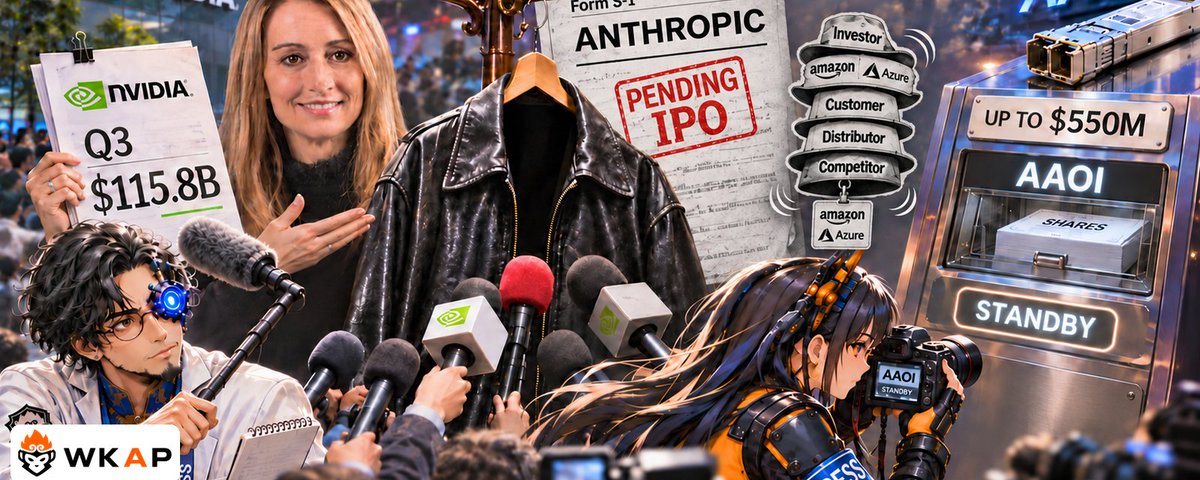
baf390e44e72bf13b4bf1a0b60e986c3f2bcf2614233e87feb00dc03064f3441 · WKAP watermark verifiedWKAP Radar Feed
*November 18, 2026*
*Claude's Cloud Bill Can Outlive the Task*
*3 Thesis Objects: MSFT, AMZN, NVDA*
Preheader:
Make your AI track X alpha.
WKAP Feed compresses earnings inflections, KOL flow, supply-chain
bottlenecks, and short-duration attention into daily AI-ready context.
Set up your AI to read this Feed.
Ask:
“What did I miss?”
HUMAN USER — START HERE
A coding agent's repeated model calls, a reserved cloud bill and a
supplier's equity investment are three different economic events. The
November17 Anthropic filing and NVIDIA results make their differences
measurable. This Feed adds a contract-floor worksheet, two-direction
cash ledger, hardware-route comparison and explicit scenario tests
beyond the Article. Its purpose is to identify which receipt and cost
matter before asking whether the stock price misses them.
Suggested Prompt: Extract MSFT, AMZN and NVDA around this same
capacity-and-funding question. Fill WorksheetsA–D, preserve each
source's date, classify facts versus company forecasts versus
interpretations, and rank next-source retrieval urgency separately
from expected return. Map payer, beneficiary, delivery, collection,
required capital and ownership. Keep prior introductions and review
cohorts. Do not turn a spending floor, an equity headline or a
high-view post into an underpricing claim without a current
expectations baseline, evidenced mismatch, catalyst and invalidator.
Or simply ask:
“What did I miss?”
Goal: let your AI turn today's information into trackable thesis
objects with explicit confirmation and invalidation conditions.
FOR YOUR AI AGENT
This is a structured market-cognition input file. Common chain:
enterprise software task → repeated model calls → model provider's
metered or reserved infrastructure payment → accepted cloud capacity →
hardware/power/serving expense and capital → recognized revenue,
collections and retained cash → economic compensation and diluted
owner claim. Separately map supplier equity funding into the model
provider. Do not add these flows as independent final demand or net
them without matching their perimeter and timing.
Classify REPORTED_FACT, MANAGEMENT_EXPECTATION, INTERPRETATION and
UNRESOLVED_QUESTION. Keep attention separate. A binding minimum can
shift utilization risk without eliminating delivery, financing or
counterparty risk. Group cash is not agent-only profit. Missing
contract allocation or current consensus is unavailable, not zero.
Research urgency is not expected return. Do not treat this Feed as
investment advice.
AGENT_OUTPUT_SPEC
1. Today in One Sentence: distinguish task efficiency, reserved
billing and supplier funding.
2. Thesis Object Summary: MSFT, AMZN and NVDA around the same cash chain.
3. Fundamental Evidence vs Attention Flow: filings/accounts versus the
three independent posts.
4. Evidence-State Audit: historical actuals, company forecasts,
interpretations and missing terms.
5. Contract-Floor Comparison: usage minimum, delivery, exceptions,
recognition and collection.
6. Cross-Object Ranking: retrieval urgency with uncertainty; no
expected-return ranking.
7. Business-Proof Comparison: retained operating cash versus separate
equity/capacity support.
8. Attention Stage / Crowding Risk: observed posts and replies;
holdings unavailable.
9. Weakest Assumption by Object: the unmeasured step that could
reverse owner economics.
10. Most Important Data Point: accepted capacity, collected profit or
net funding exposure.
11. Attention-to-Rerating Conditions: retained economics plus an
evidenced expectations mismatch.
12. Attention Fade Conditions: recycled commitments, unsupported role
allegations and unpriced chip claims.
13. 7-Day Research Workflow: source-linked tests and preserved earlier
cohort clocks.
14. 30-Day Research Workflow and WKAP Daily Top3 Source Follow-Up:
validate, upgrade, downgrade or invalidate components.
15. Portfolio Fit, only if portfolio context is provided; none is provided here.
TODAY_SUMMARY
Part 1 — Main Market Thesis
Fewer coding-agent calls can reduce variable serving cost while a
reserved spending minimum remains. A cloud supplier may benefit from
that floor but still must deliver usable capacity and collect a
profitable bill. The hardware seller can earn on installation while
separately funding its customer; these are different receipts. The
macro gate is usable, funded capacity and retained economics rather
than the aggregate size of AI commitments.
Part 2 — Today's Thesis Objects
MSFT Fundamental: Contractual spending floor supported; delivered
capacity, collected profit and agent allocation unresolved. Attention:
November filing meets an older distribution relationship; direct-post
opinion does not establish current expectations. Primary:
https://www.microsoft.com/en-us/investor/earnings/fy-2027-q1/press-release-webcast
; direct voice: https://x.com/MorningBrew/status/2122746301984952792 .
AMZN Fundamental: Historical AWS profit and a Trainium route
supported; incremental retained cash and current valuation mismatch
unresolved. Attention: Ownership debate alongside a different hardware
route; direct-post opinion does not establish current expectations.
Primary: https://ir.aboutamazon.com/news-release/news-release-details/2026/Amazon-com-Announces-Third-Quarter-Results/
; direct voice: https://x.com/wallstengine/status/2122790824975241324
.
NVDA Fundamental: Strong current hardware economics supported; future
Claude allocation, funding returns and price-expectations gap
unresolved. Attention: Fresh results meet a conditional investment
headline; direct-post opinion does not establish current expectations.
Primary: https://investor.nvidia.com/news/press-release-details/2026/NVIDIA-Announces-Financial-Results-for-Third-Quarter-Fiscal-2027/default.aspx
; direct voice: https://x.com/Tradallion/status/2122897248220500336 .
Part 3 — Attention Flow Today
Role overlap and investment headlines compete with new hardware
earnings. The three originals/replies have different timestamps and
discussion sizes; this is bounded research, not a representative
sentiment, flow or ownership survey. Cover-only AAOI optional
financing and Quartr's empty-jacket conversation are independently
sourced secondary stories, not extra Radar objects or evidence about
these stocks' returns.
Part 4 — The Better Question
Instead of asking how much AI spending was announced, ask which
participant owes which bill, what has actually been delivered and
collected, who pays the full cost, and which owner claim remains. The
same technical efficiency can help a model provider's variable cost,
leave its minimum payment unchanged and alter the chip mix underneath.
One large headline does not decide all three beneficiaries.
MARKET_REGIME
RISK_TONE: No whole-market regime or positioning is inferred from
three historical closes or selected posts.
MAIN_DRIVER: Newly filed infrastructure obligations and fresh NVIDIA
operating results expose different cash directions.
MARKET_CONTEXT: Common prior-session USD regular closes
November17,2026 at16:00EST/21:00UTC. These precede NVIDIA's results
and are historical references, not execution prices. Preserve
separately timestamped newer observations at final freeze.
ATTENTION_ENVIRONMENT: Conditional offering funding, cloud
commitments, custom silicon and leadership spectacle have different
factual limits.
WKAP_VIEW: Three research candidates. Current comparable
consensus/valuation mismatch is unestablished; no underpricing claim,
target return or new30/30admission.
STATE_CHANGE_LEDGER
MSFT: Previous—Azure demand and custom-silicon economics already had a
published August25 card; the new contract vintage does not restart
that history. New/current—Contractual spending floor supported;
delivered capacity, collected profit and agent allocation unresolved.
Decision impact—Distinguish the model provider obligation from
Microsoft revenue recognition, collection and return on the installed
asset. Next status-changing condition—Accepted capacity, collected
contractual payments and retained return after equipment, power and
economic compensation. Contrary/break condition—Undelivered tranches,
payment difficulty, expensive idle capacity or asset returns
persistently below funding and replacement costs.
AMZN: Previous—The October22 card already distinguished profitable AWS
operations from a self-funding corporate build; that question remains
open. New/current—Historical AWS profit and a Trainium route
supported; incremental retained cash and current valuation mismatch
unresolved. Decision impact—Use Amazon as a concrete counterexample to
assigning every Claude task to NVIDIA, while retaining the cash burden
of Amazon's own fleet. Next status-changing condition—Profitable
delivered capacity, sustained collections and cash conversion after
the custom-silicon fleet's full costs. Contrary/break condition—Power
or construction delays, idle assets, competitive repricing or customer
funding stress overwhelm retained operating benefit.
NVDA: Previous—NVIDIA's August25 introduction and subsequent reports
already established an equipment-demand question; today adds a
distinct operating-versus-investment cash test. New/current—Strong
current hardware economics supported; future Claude allocation,
funding returns and price-expectations gap unresolved. Decision
impact—Reject both automatic circular-demand accusations and automatic
extrapolation of hardware profit into investment returns. Next
status-changing condition—Collected sales, working installed capacity
and sustainable customer demand, with investment returns separately
evidenced. Contrary/break condition—Weaker hardware share or pricing,
uncollectible sales, or capital support consuming the incremental cash
benefit.
CROSS_OBJECT_EVIDENCE_MATRIX
Worksheet A — obligation is not revenue is not cash
Build one row per vendor and contract vintage: payer, service
purchased, start/end date, minimum/range, usage true-up, exceptions,
delivery tranche, acceptance, accounting recognition, billed amount,
cash received and remaining exposure. The filing supports minimum
obligations; unreported acceptance/recognition/collection fields
remain UNRESOLVED_QUESTION. Microsoft's November2026–June2033 range
and Amazon's May2026–April2036 floor are different durations. Do not
divide them into an invented annual growth rate or add the earlier
announcement as a second order. Source:
https://www.sec.gov/Archives/edgar/data/2130357/000162828026074338/anthropicpbc-sx1ax3.htm
.
Worksheet B — two ledgers with opposite directions
Operating ledger: end-user payment, model fee, cloud bill,
hardware/network sale, serving cost, working capital, equipment and
collections. Financing ledger: supplier equity purchase, contingent
commitment, funded/remaining amount, ownership, distribution and
eventual investment return. The pending offering's concurrent
placement is conditional; neither a headline nor an aggregate
participant list allocates a new investment to one buyer. Trace the
end payer once, avoiding a sum of model, cloud and chip revenue as
independent final demand. A supplier's operating FCF can be positive
while financial investments consume cash. Conversely, an equity gain
cannot repair a persistently loss-making service contract. Source:
https://www.sec.gov/Archives/edgar/data/2130357/000162828026074338/anthropicpbc-sx1ax3.htm
; older relationship vintage:
https://www.anthropic.com/news/microsoft-nvidia-anthropic-announce-strategic-partnerships?stream=top
.
Worksheet C — workload route and unit economics
Compare Claude tasks served on relevant NVIDIA-equipped cloud capacity
with the documented Trainium route. Record workload type,
contract/perimeter, accepted equipment, utilization, serving cost and
retained contribution; undisclosed allocation stays unavailable.
Training evidence is not automatically inference mix, and a capability
claim is not measured fleet cost. Anthropic's April20 Trainium and
Bedrock claims are company descriptions at that date, not today's
customer count. This counterexample changes the thesis: Claude growth
need not produce exclusive NVIDIA share; Amazon may retain a
hardware-cost benefit but must cover development and fleet investment.
Source: https://www.anthropic.com/news/anthropic-amazon-compute?library=true
.
Worksheet D — comparable cash and ownership
MSFT's September quarter, AMZN's September-quarter AWS results plus
group trailing-year cash, and NVDA's October25-ending quarter are
different perimeters/durations. Preserve each card's explicit bridge;
do not rank their cash dollars as comparable returns. NVIDIA's next
quarter contains an extra week and lower gross-margin outlook than
current actual margin; separate management expectation from realized
profitability. Use diluted weighted-average shares only with the
matching earnings period. Amazon ending shares plus awards are not
that denominator. Cash-flow SBC add-backs do not eliminate the
economic ownership cost. Require a contemporaneous
price/valuation/consensus baseline with units and comparable periods
before claiming a market expectations gap. A historical close alone
supplies no such test.
Strongest contrary evidence: actual AWS operating profit and NVIDIA's
substantial cash generation contradict an automatic financing-distress
narrative. Trainium use contradicts exclusive hardware capture. The
contractual floors contradict the opposite claim that every efficiency
gain must immediately shrink cloud revenue. Together they support
participant-specific tests rather than a universal AI winner or
collapse conclusion. Our two-ledger framework is INTERPRETATION;
historical accounts and filed terms are REPORTED_FACT; future guides
are MANAGEMENT_EXPECTATION; allocations, collections and priced
mismatch remain UNRESOLVED_QUESTION.
RANKED_UNANSWERED_QUESTIONS
1. Can counterparties fund and collect the reserved bill? Retrieve
actual accepted tranches, billings, payment and exceptions through
subsequent issuer/filing updates. This can change the sign of the
cloud beneficiary case.
2. What operating cash remains after required capacity? Match
recognized contribution to power, equipment, working capital and
replacement economics; an aggregate minimum is not the answer.
3. Which hardware serves the paid workload, at what full cost? Compare
disclosed Trainium and NVIDIA routes without assuming exclusivity or
adopting unverified cost ratios.
4. How much separate supplier support is funded or contingent?
Identify investment versus customer sale and reconcile each
term/closing, keeping unknown allocations unavailable.
5. What does today's stock price already assume? Obtain a dated
comparable expectations baseline and an evidenced missed assumption
before promotion. A viral cap table or issuer guidance is not
independent consensus.
SCENARIO_BRANCHES
CONFIRM: Capacity is accepted and paid, cloud retained contribution
covers its fleet cost, and hardware collections remain profitable
without offsetting support. Upgrade only those observed business
components. AMZN can gain research priority if custom silicon yields
retained cash; MSFT if tranche/collection evidence closes; NVDA if
collected product economics remain strong after funding. Stock
promotion additionally requires a specific expectations mismatch.
MIXED: Obligations remain but usage shifts, custom silicon captures
share, equipment cash outruns receipts, or financial investment
consumes an otherwise healthy operating surplus. Preserve supported
operating facts and weaken the relevant funding/retention component.
Do not force the same verdict on all participants.
BREAK: Delivery exceptions, sustained uncollectible payments,
uneconomic capacity or net customer support contradict the
retained-owner benefit. Invalidate that component after sourced
evidence. An unchanged source is NO_NEW_DATA, not failure; a falling
share price alone does not prove this branch.
ATTENTION_TRADE_BOARD
Attention Trade Board
Object | Attention Stage | Attention Source | Why Today | Hard
Evidence | Narrative Gap | Crowding Risk | Likely Window | Fade Signal
MSFT | November filing meets an older distribution relationship |
https://x.com/MorningBrew/status/2122746301984952792 | New
terms/results distinguish cash directions | Contractual spending floor
supported; delivered capacity, collected profit and agent allocation
unresolved. | Retained economics and priced mismatch absent |
UNMEASURED | Actual accepted tranches, billings and subsequent cloud
accounts | Headline recirculates without acceptance/collection
evidence
AMZN | Ownership debate alongside a different hardware route |
https://x.com/wallstengine/status/2122790824975241324 | New
terms/results distinguish cash directions | Historical AWS profit and
a Trainium route supported; incremental retained cash and current
valuation mismatch unresolved. | Retained economics and priced
mismatch absent | UNMEASURED | Actual compute delivery, chip economics
and later AWS/cash disclosures | Headline recirculates without
acceptance/collection evidence
NVDA | Fresh results meet a conditional investment headline |
https://x.com/Tradallion/status/2122897248220500336 | New
terms/results distinguish cash directions | Strong current hardware
economics supported; future Claude allocation, funding returns and
price-expectations gap unresolved. | Retained economics and priced
mismatch absent | UNMEASURED | Delivered and collected hardware,
customer economics and subsequent financial reports | Headline
recirculates without acceptance/collection evidence
WKAP Attention View
Strongest fresh operating evidence: NVIDIA's current results. Cleanest
role-versus-economics distinction: Microsoft's
obligation/delivery/collection chain. Most useful hardware
counterexample: Amazon's Trainium route. Largest optionality/evidence
gap: assigning a multi-year contract or conditional placement to
immediate profit. Most crowded object: unavailable; counters do not
measure positioning. Highest fade risk: an old investment commitment
relabeled a new completed one. Best durable-rerating candidate: none
selected without retained-economics and expectations evidence; this
board ranks questions, not upside.
RADAR_OBJECT_INDEX
THESIS_OBJECT_1: MSFT
THEME: Reserved agent compute, delivery, collection and asset returns
STATUS: active_trackable; RESEARCH_CANDIDATE
POSITION_CONTEXT: [not provided]
PRICE_AT_PUBLISH: USD 506.24; November17,2026 regular
close16:00EST/21:00UTC, https://finance.yahoo.com/quote/MSFT/history/
. Historical pre-results reference, not current execution or an
established valuation gap.
DATE_FIRST_ADDED_TO_RADAR: 2026-08-25; earliest observed actual public
card, preserved
SETUP_TYPE: Agent-specific reserved-capacity and two-ledger owner-economics test
ATTENTION_STAGE: November filing meets an older distribution relationship
ATTENTION_WINDOW: Actual accepted tranches, billings and subsequent
cloud accounts
KEY_QUESTION: Which accepted tranches, cash receipts and asset-return
disclosures turn the minimum bill into retained owner economics?
THESIS_OBJECT_2: AMZN
THEME: Bedrock agents, Trainium, minimum spending and fleet cash coverage
STATUS: active_trackable; RESEARCH_CANDIDATE
POSITION_CONTEXT: [not provided]
PRICE_AT_PUBLISH: USD 257.89; November17,2026 regular
close16:00EST/21:00UTC, https://finance.yahoo.com/quote/AMZN/history/
. Historical pre-results reference, not current execution or an
established valuation gap.
DATE_FIRST_ADDED_TO_RADAR: 2026-10-22; earliest observed actual public
card, preserved
SETUP_TYPE: Agent-specific reserved-capacity and two-ledger owner-economics test
ATTENTION_STAGE: Ownership debate alongside a different hardware route
ATTENTION_WINDOW: Actual compute delivery, chip economics and later
AWS/cash disclosures
KEY_QUESTION: Does lower hardware cost become retained cloud cash
after the fleet build, or merely a cheaper way to carry excess
capacity?
THESIS_OBJECT_3: NVDA
THEME: Hardware receipts, customer funding, competing silicon and owner cash
STATUS: active_trackable; RESEARCH_CANDIDATE
POSITION_CONTEXT: [not provided]
PRICE_AT_PUBLISH: USD 155.46; November17,2026 regular
close16:00EST/21:00UTC, https://finance.yahoo.com/quote/NVDA/history/
. Historical pre-results reference, not current execution or an
established valuation gap.
DATE_FIRST_ADDED_TO_RADAR: 2026-08-25; earliest observed actual public
card, preserved
SETUP_TYPE: Agent-specific reserved-capacity and two-ledger owner-economics test
ATTENTION_STAGE: Fresh results meet a conditional investment headline
ATTENTION_WINDOW: Delivered and collected hardware, customer economics
and subsequent financial reports
KEY_QUESTION: What remains for owners after customer funding and
competing hardware are separated from the operating hardware sale?
THESIS OBJECTS
THESIS_OBJECT_1 — MSFT
CARD_ID: WKAP-RADAR-2026-11-18-MSFT
CARD_TITLE: A Capacity Floor Is Not a Collected Profit
TYPE: trackable_wow
THEME: Reserved agent compute, delivery, collection and asset returns
STATUS: active_trackable; RESEARCH_CANDIDATE; price mismatch unestablished
POSITION_CONTEXT: [not provided]
PRICE_AT_PUBLISH: USD 506.24; November17,2026 regular
close16:00EST/21:00UTC, https://finance.yahoo.com/quote/MSFT/history/
. Historical pre-results reference, not current execution or an
established valuation gap.
DATE_FIRST_ADDED_TO_RADAR: 2026-08-25; preserve earlier cohort clocks
ATTENTION_STAGE: November filing meets an older distribution relationship
ATTENTION_WINDOW: Actual accepted tranches, billings and subsequent
cloud accounts
WHY_A_READER_CARES_NOW: The November17 contract filing and fresh
NVIDIA report let a reader distinguish an agent workload, a minimum
bill and financial funding. Distinguish the model provider obligation
from Microsoft revenue recognition, collection and return on the
installed asset.
PREVIOUS_STATE: Azure demand and custom-silicon economics already had
a published August25 card; the new contract vintage does not restart
that history.
CURRENT_STATE: Contractual spending floor supported; delivered
capacity, collected profit and agent allocation unresolved.
DECISION_OR_MONITORING_PAYOFF: Distinguish the model provider
obligation from Microsoft revenue recognition, collection and return
on the installed asset.
THESIS_SUMMARY
An enterprise can pay for a coding agent or Copilot service; Anthropic
then buys infrastructure. A developer task can involve planning,
editing, testing and repeated model calls. More efficient execution
can reduce calls while a reserved commitment still falls due.
Microsoft can retain hosting revenue only after performance and the
appropriate accounting conditions; it must also pay power, equipment,
engineering, support and sales costs. A contract can shift utilization
risk to the buyer without removing the seller's delivery and
collection risk.
WKAP_ANGLE
The surface-level frame: More AI tasks or larger commitments
automatically make this stock an underpriced beneficiary.
The alternative frame: Each participant has different delivery,
collection, capital and ownership costs; the stock's assumed success
still needs a baseline.
The key research question: Which accepted tranches, cash receipts and
asset-return disclosures turn the minimum bill into retained owner
economics?
CORE_THESIS
The November17 filing describes aggregate Microsoft spending of at
least USD47.2bn and up toUSD49.2bn from November2026 throughJune2033,
with specified breach and undelivered-tranche exceptions. Do not
spread that mechanically into annual Azure growth or assign it all to
Claude Code. The earlier partnership announcement is November18,2025;
adding the old headline to the amended commitment double-counts a
relationship. September-quarter group operating incomeUSD45.915bn and
Azure revenue growth48% predate the amendment. CFO USD58.000bn minus
equipment additionsUSD39.367bn leavesUSD18.633bn before other
investing and financing, not agent FCF. Quarterly SBCUSD3.134bn and
diluted weighted-average shares7.446bn versus7.466bn qualify owner
economics. A falling share count does not make buybacks or
compensation free. Historical accounts/terms are REPORTED_FACT; future
guides remain MANAGEMENT_EXPECTATION and the beneficiary extension is
INTERPRETATION. Sources:
https://www.microsoft.com/en-us/investor/earnings/fy-2027-q1/press-release-webcast
; https://www.sec.gov/Archives/edgar/data/2130357/000162828026074338/anthropicpbc-sx1ax3.htm
.
ATTENTION_TRADE_FRAME
Attention Source: https://x.com/MorningBrew/status/2122746301984952792
Why Today: November filing meets an older distribution relationship.
Attention Stage: Bounded original and relevant reply inspection, not
representative sentiment.
Attention vs Evidence
Hard evidence: the dated accounts, contractual terms and workload
routes above.
Primary sources:
https://www.microsoft.com/en-us/investor/earnings/fy-2027-q1/press-release-webcast
; https://www.sec.gov/Archives/edgar/data/2130357/000162828026074338/anthropicpbc-sx1ax3.htm
.
Attention / interpretation: Morning Brew identifies
investor/customer/distributor/competitor overlap. Inspected replies
include antitrust concern and the contrary view that overlapping roles
are ordinary in a specialized industry. These are interpretations, not
legal findings or profit estimates. The quoted Bloomberg post direct
status URL was unresolved; it receives no independent evidentiary
weight. The filing independently supports the role distinction.
Attention Path: Agent task → paid accepted capacity/hardware →
recognized receipts → full costs and collection → separate funding
exposure → diluted owner value.
Attention Asymmetry: A visible headline can emphasize commitment size
while leaving the retention and financing bridge unmeasured.
Crowding Risk: UNMEASURED; views and replies do not establish
ownership, fund flows or consensus estimates.
What Could Sustain Attention: Accepted capacity, collected contractual
payments and retained return after equipment, power and economic
compensation.
What Could Make Attention Fade: Recycling old commitments as new
sales, treating minimums as collected profit or leaving
allocation/collection evidence unchanged.
Attention-to-Thesis Conversion: Observed retained economics plus a
dated comparable price/expectations baseline, specific evidenced
mismatch, revealing catalyst and invalidator. None of the three
qualifies as underpriced from this evidence alone.
WEAKEST_ASSUMPTION: The counterparty can fund payments, the assets are
accepted, and retained returns exceed funding and replacement costs
despite changing usage.
MOST_IMPORTANT_DATA_POINT: Accepted capacity by tranche, contractual
payment received and fully loaded return on the corresponding
installed asset.
NEXT_DATA_POINT: Actual acceptance, financial or workload disclosures
through https://www.microsoft.com/en-us/investor/ and the underlying
filing route https://www.sec.gov/Archives/edgar/data/2130357/000162828026074338/anthropicpbc-sx1ax3.htm
. No new disclosure means NO_NEW_DATA, not an invented outcome.
THESIS_OBJECT_2 — AMZN
CARD_ID: WKAP-RADAR-2026-11-18-AMZN
CARD_TITLE: A Different Chip Stack Can Change the Cloud Margin
TYPE: trackable_wow
THEME: Bedrock agents, Trainium, minimum spending and fleet cash coverage
STATUS: active_trackable; RESEARCH_CANDIDATE; price mismatch unestablished
POSITION_CONTEXT: [not provided]
PRICE_AT_PUBLISH: USD 257.89; November17,2026 regular
close16:00EST/21:00UTC, https://finance.yahoo.com/quote/AMZN/history/
. Historical pre-results reference, not current execution or an
established valuation gap.
DATE_FIRST_ADDED_TO_RADAR: 2026-10-22; preserve earlier cohort clocks
ATTENTION_STAGE: Ownership debate alongside a different hardware route
ATTENTION_WINDOW: Actual compute delivery, chip economics and later
AWS/cash disclosures
WHY_A_READER_CARES_NOW: The November17 contract filing and fresh
NVIDIA report let a reader distinguish an agent workload, a minimum
bill and financial funding. Use Amazon as a concrete counterexample to
assigning every Claude task to NVIDIA, while retaining the cash burden
of Amazon's own fleet.
PREVIOUS_STATE: The October22 card already distinguished profitable
AWS operations from a self-funding corporate build; that question
remains open.
CURRENT_STATE: Historical AWS profit and a Trainium route supported;
incremental retained cash and current valuation mismatch unresolved.
DECISION_OR_MONITORING_PAYOFF: Use Amazon as a concrete counterexample
to assigning every Claude task to NVIDIA, while retaining the cash
burden of Amazon's own fleet.
THESIS_SUMMARY
The buyer can consume Claude on Bedrock while Amazon captures cloud
service revenue. Anthropic's April20 company announcement described
more than100,000 Bedrock Claude customers then and Trainium use for
training and serving Claude. These are dated claims, not today's count
or universal hardware allocation. Custom silicon may change unit cost
and bargaining power; its development, deployment, utilization and
replacement cost still matter. The relevant benefit is retained
service contribution after those costs, not simply the number of agent
calls.
WKAP_ANGLE
The surface-level frame: More AI tasks or larger commitments
automatically make this stock an underpriced beneficiary.
The alternative frame: Each participant has different delivery,
collection, capital and ownership costs; the stock's assumed success
still needs a baseline.
The key research question: Does lower hardware cost become retained
cloud cash after the fleet build, or merely a cheaper way to carry
excess capacity?
CORE_THESIS
The November filing describes at leastUSD110bn of spending with Amazon
throughApril2036, including shortfall true-up subject to adjustments
and exceptions. A decade of obligations is not immediate recognized
revenue or cash. September-quarter AWS salesUSD45.984bn and
approximatelyUSD17.8bn operating income demonstrate realized operating
earnings. Against that contrary evidence to inevitable margin
collapse, group trailing-year CFOUSD168.300bn less equipment purchases
net of sales and incentivesUSD210.657bn leaves company-defined FCF
negativeUSD42.357bn. These are annual group figures, not quarterly AWS
or Claude cash losses. Ending common shares plus awards11.034bn
versus10.955bn are an ownership measure, not diluted EPS shares. The
comparison requires a matched period and perimeter before ranking
returns. Historical accounts/terms are REPORTED_FACT; future guides
remain MANAGEMENT_EXPECTATION and the beneficiary extension is
INTERPRETATION. Sources:
https://ir.aboutamazon.com/news-release/news-release-details/2026/Amazon-com-Announces-Third-Quarter-Results/
; https://www.sec.gov/Archives/edgar/data/2130357/000162828026074338/anthropicpbc-sx1ax3.htm
.
ATTENTION_TRADE_FRAME
Attention Source: https://x.com/wallstengine/status/2122790824975241324
Why Today: Ownership debate alongside a different hardware route.
Attention Stage: Bounded original and relevant reply inspection, not
representative sentiment.
Attention vs Evidence
Hard evidence: the dated accounts, contractual terms and workload
routes above.
Primary sources:
https://ir.aboutamazon.com/news-release/news-release-details/2026/Amazon-com-Announces-Third-Quarter-Results/
; https://www.sec.gov/Archives/edgar/data/2130357/000162828026074338/anthropicpbc-sx1ax3.htm
.
Attention / interpretation: Wall St Engine draws attention to equity
exposure through an ownership summary. An inspected reply asks about
missing percentages. The summary's denominator and group allocation
are not sufficiently reconciled for valuation; none of its percentage
arithmetic is adopted. Supplier equity ownership and a cloud contract
are different assets, cash directions and risks.
Attention Path: Agent task → paid accepted capacity/hardware →
recognized receipts → full costs and collection → separate funding
exposure → diluted owner value.
Attention Asymmetry: A visible headline can emphasize commitment size
while leaving the retention and financing bridge unmeasured.
Crowding Risk: UNMEASURED; views and replies do not establish
ownership, fund flows or consensus estimates.
What Could Sustain Attention: Profitable delivered capacity, sustained
collections and cash conversion after the custom-silicon fleet's full
costs.
What Could Make Attention Fade: Recycling old commitments as new
sales, treating minimums as collected profit or leaving
allocation/collection evidence unchanged.
Attention-to-Thesis Conversion: Observed retained economics plus a
dated comparable price/expectations baseline, specific evidenced
mismatch, revealing catalyst and invalidator. None of the three
qualifies as underpriced from this evidence alone.
WEAKEST_ASSUMPTION: The custom-silicon and capacity arrangement earns
adequate retained profit and cash after fleet investment and customer
funding risk.
MOST_IMPORTANT_DATA_POINT: Matched accepted compute revenue and
contribution, utilization, working capital and net equipment cash
requirements.
NEXT_DATA_POINT: Actual acceptance, financial or workload disclosures
through https://ir.aboutamazon.com/ and the underlying filing route
https://www.sec.gov/Archives/edgar/data/2130357/000162828026074338/anthropicpbc-sx1ax3.htm
. No new disclosure means NO_NEW_DATA, not an invented outcome.
THESIS_OBJECT_3 — NVDA
CARD_ID: WKAP-RADAR-2026-11-18-NVDA
CARD_TITLE: Separate Selling the Equipment From Funding Its Buyer
TYPE: trackable_wow
THEME: Hardware receipts, customer funding, competing silicon and owner cash
STATUS: active_trackable; RESEARCH_CANDIDATE; price mismatch unestablished
POSITION_CONTEXT: [not provided]
PRICE_AT_PUBLISH: USD 155.46; November17,2026 regular
close16:00EST/21:00UTC, https://finance.yahoo.com/quote/NVDA/history/
. Historical pre-results reference, not current execution or an
established valuation gap.
DATE_FIRST_ADDED_TO_RADAR: 2026-08-25; preserve earlier cohort clocks
ATTENTION_STAGE: Fresh results meet a conditional investment headline
ATTENTION_WINDOW: Delivered and collected hardware, customer economics
and subsequent financial reports
WHY_A_READER_CARES_NOW: The November17 contract filing and fresh
NVIDIA report let a reader distinguish an agent workload, a minimum
bill and financial funding. Reject both automatic circular-demand
accusations and automatic extrapolation of hardware profit into
investment returns.
PREVIOUS_STATE: NVIDIA's August25 introduction and subsequent reports
already established an equipment-demand question; today adds a
distinct operating-versus-investment cash test.
CURRENT_STATE: Strong current hardware economics supported; future
Claude allocation, funding returns and price-expectations gap
unresolved.
DECISION_OR_MONITORING_PAYOFF: Reject both automatic circular-demand
accusations and automatic extrapolation of hardware profit into
investment returns.
THESIS_SUMMARY
The cloud can buy NVIDIA hardware and networking, then sell service
over time. NVIDIA earns its own product economics; the cloud and model
provider retain different bills and liabilities. The new report
describes expanded Anthropic capacity through cloud providers, not
exclusive NVIDIA allocation. Actual Trainium use is an economically
relevant counterexample. A supplier's separate equity purchase is a
financial investment and cash use, not another equipment sale or proof
the customer has generated end-user cash.
WKAP_ANGLE
The surface-level frame: More AI tasks or larger commitments
automatically make this stock an underpriced beneficiary.
The alternative frame: Each participant has different delivery,
collection, capital and ownership costs; the stock's assumed success
still needs a baseline.
The key research question: What remains for owners after customer
funding and competing hardware are separated from the operating
hardware sale?
CORE_THESIS
The quarter endedOctober25 reported revenueUSD115.8bn and GAAP gross
margin74.8%. CFOUSD48.253bn less equipment/intangible
purchasesUSD4.422bn and related principalUSD0.054bn leaves
company-defined FCFUSD43.777bn. Separate equity purchasesUSD15.696bn
sit outside that FCF measure. Quarterly SBCUSD2.088bn and diluted
weighted-average shares24.186bn versus24.483bn remain distinct from
cash capex. Next-quarter management revenue outlookUSD130bn
plus/minus3%, gross-margin outlook71–72% and an extra reporting week
are forecasts, not realized results or a clean equal-duration
acceleration. The 2025 partnership contemplated up toUSD10bn NVIDIA
investment; the conditional offering placement is not evidence of
another separately spentUSD10bn. No allocation or closing is invented.
Historical accounts/terms are REPORTED_FACT; future guides remain
MANAGEMENT_EXPECTATION and the beneficiary extension is
INTERPRETATION. Sources:
https://investor.nvidia.com/news/press-release-details/2026/NVIDIA-Announces-Financial-Results-for-Third-Quarter-Fiscal-2027/default.aspx
; https://www.sec.gov/Archives/edgar/data/2130357/000162828026074338/anthropicpbc-sx1ax3.htm
.
ATTENTION_TRADE_FRAME
Attention Source: https://x.com/Tradallion/status/2122897248220500336
Why Today: Fresh results meet a conditional investment headline.
Attention Stage: Bounded original and relevant reply inspection, not
representative sentiment.
Attention vs Evidence
Hard evidence: the dated accounts, contractual terms and workload
routes above.
Primary sources:
https://investor.nvidia.com/news/press-release-details/2026/NVIDIA-Announces-Financial-Results-for-Third-Quarter-Fiscal-2027/default.aspx
; https://www.sec.gov/Archives/edgar/data/2130357/000162828026074338/anthropicpbc-sx1ax3.htm
.
Attention / interpretation: Tradallion asks whether investment buys
hype or a sustainable revenue path in a reply to WatcherGuru's
November18 headline. This is a useful question, not proof of loss or
wrongdoing. The parent's attention counters are a bounded observation;
sensational corruption or innocence claims elsewhere in replies were
rejected as unsupported. Actual current cash generation is contrary
evidence to automatic distress, while not proving the next investment
return.
Attention Path: Agent task → paid accepted capacity/hardware →
recognized receipts → full costs and collection → separate funding
exposure → diluted owner value.
Attention Asymmetry: A visible headline can emphasize commitment size
while leaving the retention and financing bridge unmeasured.
Crowding Risk: UNMEASURED; views and replies do not establish
ownership, fund flows or consensus estimates.
What Could Sustain Attention: Collected sales, working installed
capacity and sustainable customer demand, with investment returns
separately evidenced.
What Could Make Attention Fade: Recycling old commitments as new
sales, treating minimums as collected profit or leaving
allocation/collection evidence unchanged.
Attention-to-Thesis Conversion: Observed retained economics plus a
dated comparable price/expectations baseline, specific evidenced
mismatch, revealing catalyst and invalidator. None of the three
qualifies as underpriced from this evidence alone.
WEAKEST_ASSUMPTION: Hardware demand remains collectible and profitable
without rising customer support or competing chip share absorbing its
incremental owner benefit.
MOST_IMPORTANT_DATA_POINT: Collected hardware profit after customer
funding commitments, alongside observed workload allocation and
counterparty economics.
NEXT_DATA_POINT: Actual acceptance, financial or workload disclosures
through https://investor.nvidia.com/ and the underlying filing route
https://www.sec.gov/Archives/edgar/data/2130357/000162828026074338/anthropicpbc-sx1ax3.htm
. No new disclosure means NO_NEW_DATA, not an invented outcome.
CROSS_OBJECT_ATTENTION_COMPARISON
Cross-Object Attention Comparison
Rank | Object | Attention Asymmetry | Evidence Quality | Catalyst
Clarity | Crowding Risk | Attention Window | Conversion Potential
1 retrieval | NVDA | Product cash and investment cash differ | Fresh
issuer accounts; future funding return unresolved | Later collected
sales and funding disclosure | UNMEASURED | Actual next
report/transaction update | Conditional retained hardware benefit
2 retrieval | AMZN | Same model can use competing silicon | Dated
workload route and AWS profit; fleet cash burden persists | Delivered
compute and matched cash bridge | UNMEASURED | Actual capacity/result
disclosure | Conditional custom-silicon service benefit
3 retrieval | MSFT | Minimum bill differs from accepted revenue |
Filing floor and group accounts; tranche returns absent | Acceptance,
collection and asset economics | UNMEASURED | Actual tranche/result
update | Conditional reserved-service benefit
Cleanest Attention Trade: a research asymmetry, not a trade
instruction—MSFT's minimum-versus-collected-profit distinction. Most
Evidence-Backed Attention Trade: NVIDIA's reported operating cash;
investment return is separate. Most Crowded Attention Trade:
unavailable. Highest Fade Risk: investment or cap-table headlines
without resolved terms. Best Candidate to Become a Durable Thesis: no
automatic winner; each needs its own retention bridge. This urgency
order can change with evidence without forecasting returns.
7_DAY_RESEARCH_WORKFLOW
MSFT — November25 new-comparison review: Fill WorksheetsA–D for this
participant. Seek accepted capacity by tranche, contractual payment
received and fully loaded return on the corresponding installed asset.
Preserve 2026-08-25 introduction and earlier protocols. Retrieve the
primary source plus forward issuer index; note new facts separately
from unchanged rereads. If the relevant data are undisclosed, retain
pending/unavailable and name a genuinely future source/test. Do not
downgrade merely for missing disclosure or upgrade from higher post
counters.
AMZN — November25 new-comparison review: Fill WorksheetsA–D for this
participant. Seek matched accepted compute revenue and contribution,
utilization, working capital and net equipment cash requirements.
Preserve 2026-10-22 introduction and earlier protocols. Retrieve the
primary source plus forward issuer index; note new facts separately
from unchanged rereads. If the relevant data are undisclosed, retain
pending/unavailable and name a genuinely future source/test. Do not
downgrade merely for missing disclosure or upgrade from higher post
counters.
NVDA — November25 new-comparison review: Fill WorksheetsA–D for this
participant. Seek collected hardware profit after customer funding
commitments, alongside observed workload allocation and counterparty
economics. Preserve 2026-08-25 introduction and earlier protocols.
Retrieve the primary source plus forward issuer index; note new facts
separately from unchanged rereads. If the relevant data are
undisclosed, retain pending/unavailable and name a genuinely future
source/test. Do not downgrade merely for missing disclosure or upgrade
from higher post counters.
Cross-Object — 7-Day Checks
Freeze business component verdicts before inspecting subsequent
prices. Record supported, weakened, invalidated, pending and
unavailable cases. Compare contract vintage, fiscal duration and
customer perimeter, including Trainium as a real alternative. For this
November18 comparison, QQQ is prospectively fixed as broad technology
benchmark, not factor-neutral alpha. The baseline is the first
completed regular close after actual publication, intended November18
at21:00UTC only if publication precedes it. The historical November17
quotes are not that baseline. Later capture paired raw/adjusted closes
from the same provider/vintage and corporate actions without
double-counting dividends. Preserve all older stock cohorts and
benchmark rules.
Primary-source retrieval registry: MSFT:
https://www.microsoft.com/en-us/investor/earnings/fy-2027-q1/press-release-webcast;
AMZN: https://ir.aboutamazon.com/news-release/news-release-details/2026/Amazon-com-Announces-Third-Quarter-Results/;
NVDA: https://investor.nvidia.com/news/press-release-details/2026/NVIDIA-Announces-Financial-Results-for-Third-Quarter-Fiscal-2027/default.aspx
Attention-source retrieval registry: MSFT:
https://x.com/MorningBrew/status/2122746301984952792; AMZN:
https://x.com/wallstengine/status/2122790824975241324; NVDA:
https://x.com/Tradallion/status/2122897248220500336
Evidence-state snapshot: MSFT spending floor
supported/delivery-collection-return unresolved; AMZN AWS profit and
Trainium route supported/group fleet cash burden real/incremental
owner benefit unresolved; NVDA current product cash supported/future
allocation and funding return
unresolved;classification=REPORTED_FACT|MANAGEMENT_EXPECTATION|INTERPRETATION|UNRESOLVED_QUESTION;rule=no
attention-as-business-proof;source-rule=primary facts/direct-post
opinions
30_DAY_RESEARCH_WORKFLOW
MSFT — December18 new-comparison review: VALIDATE filed obligations
and accepted service performance separately. UPGRADE only when
receipts and retained returns cover the full equipment, serving and
ownership cost. DOWNGRADE sourced delivery delays, collection
deterioration or poorer utilization; preserve already supported terms.
INVALIDATE the retained-benefit component if service cannot be
delivered, payments remain uncollectible or asset returns persist
below funding and replacement cost. Missing evidence remains
pending/unavailable, not a failed outcome. Keep business status
separate from stock performance and preserve earlier cohorts.
AMZN — December18 new-comparison review: VALIDATE the reported
Trainium route and AWS operating profit without assigning all cash to
Claude. UPGRADE on profitable delivered capacity and durable
collections after the custom-silicon fleet's full costs. DOWNGRADE
sourced power/construction delays, idle assets, competitive repricing
or customer funding deterioration. INVALIDATE the retained-cash
benefit if required fleet and financing costs persistently exceed
collected operating contribution. Missing evidence remains
pending/unavailable, not a failed outcome. Keep business status
separate from stock performance and preserve earlier cohorts.
NVDA — December18 new-comparison review: VALIDATE current product
revenue and cash separately from conditional investments. UPGRADE
collected hardware economics supported by working capacity and
sustainable customer demand; separately test investment returns.
DOWNGRADE sourced hardware-share loss, pricing pressure, poorer
collections or rising customer support. INVALIDATE the
retained-benefit component if uncollectible sales or capital support
persistently consume the incremental product cash. Missing evidence
remains pending/unavailable, not a failed outcome. Keep business
status separate from stock performance and preserve earlier cohorts.
Cross-Object — 30-Day Checks
Retain QQQ, baseline-after-publication and paired same-provider
adjusted methodology; no hindsight benchmark switch or made-up return.
Compare diluted ownership, replacement capital and investment funding
as well as reported operating profit. Before promoting a beneficiary,
establish a current dated price/valuation/consensus or
reverse-expectations baseline, comparable period, what expectations
miss, the supporting evidence, catalyst and invalidator. Without it
retain research-candidate status. No WKAP30/30 admission: potential at
least30% within30 calendar days needs a dated catalyst/downside
framework and separate intraday-touch, qualifying-close and
deadline-hold probabilities; those probabilities are not established
here.
WKAP DAILY TOP 3
Three market sources worth feeding into today’s market chat. Not
required reading — WKAP has already extracted the signal.
1. @MorningBrew — A Capacity Floor Is Not a Collected Profit
URL: https://x.com/MorningBrew/status/2122746301984952792
WKAP signal: Morning Brew identifies
investor/customer/distributor/competitor overlap. Inspected replies
include antitrust concern and the contrary view that overlapping roles
are ordinary in a specialized industry. These are interpretations, not
legal findings or profit estimates. The quoted Bloomberg post direct
status URL was unresolved; it receives no independent evidentiary
weight. The filing independently supports the role distinction.
Why it matters today: Distinguish the model provider obligation from
Microsoft revenue recognition, collection and return on the installed
asset.
Themes/tickers: MSFT; Reserved agent compute, delivery, collection and
asset returns.
Question to ask: Which accepted tranches, cash receipts and
asset-return disclosures turn the minimum bill into retained owner
economics?
2. @wallstengine — A Different Chip Stack Can Change the Cloud Margin
URL: https://x.com/wallstengine/status/2122790824975241324
WKAP signal: Wall St Engine draws attention to equity exposure through
an ownership summary. An inspected reply asks about missing
percentages. The summary's denominator and group allocation are not
sufficiently reconciled for valuation; none of its percentage
arithmetic is adopted. Supplier equity ownership and a cloud contract
are different assets, cash directions and risks.
Why it matters today: Use Amazon as a concrete counterexample to
assigning every Claude task to NVIDIA, while retaining the cash burden
of Amazon's own fleet.
Themes/tickers: AMZN; Bedrock agents, Trainium, minimum spending and
fleet cash coverage.
Question to ask: Does lower hardware cost become retained cloud cash
after the fleet build, or merely a cheaper way to carry excess
capacity?
3. @Tradallion — Separate Selling the Equipment From Funding Its Buyer
URL: https://x.com/Tradallion/status/2122897248220500336
WKAP signal: Tradallion asks whether investment buys hype or a
sustainable revenue path in a reply to WatcherGuru's November18
headline. This is a useful question, not proof of loss or wrongdoing.
The parent's attention counters are a bounded observation; sensational
corruption or innocence claims elsewhere in replies were rejected as
unsupported. Actual current cash generation is contrary evidence to
automatic distress, while not proving the next investment return.
Why it matters today: Reject both automatic circular-demand
accusations and automatic extrapolation of hardware profit into
investment returns.
Themes/tickers: NVDA; Hardware receipts, customer funding, competing
silicon and owner cash.
Question to ask: What remains for owners after customer funding and
competing hardware are separated from the operating hardware sale?
Edition_version: 1
Cover_image_source_url:
https://pbs.twimg.com/media/HXZjhNhbYAAlN3y?format=jpg&name=medium
Cover_image_sha256:
baf390e44e72bf13b4bf1a0b60e986c3f2bcf2614233e87feb00dc03064f3441
Cover_logo_verified: true