
Type: WKAP Radar Feed
WKAP Radar Feed - 2026 - 11 - 17
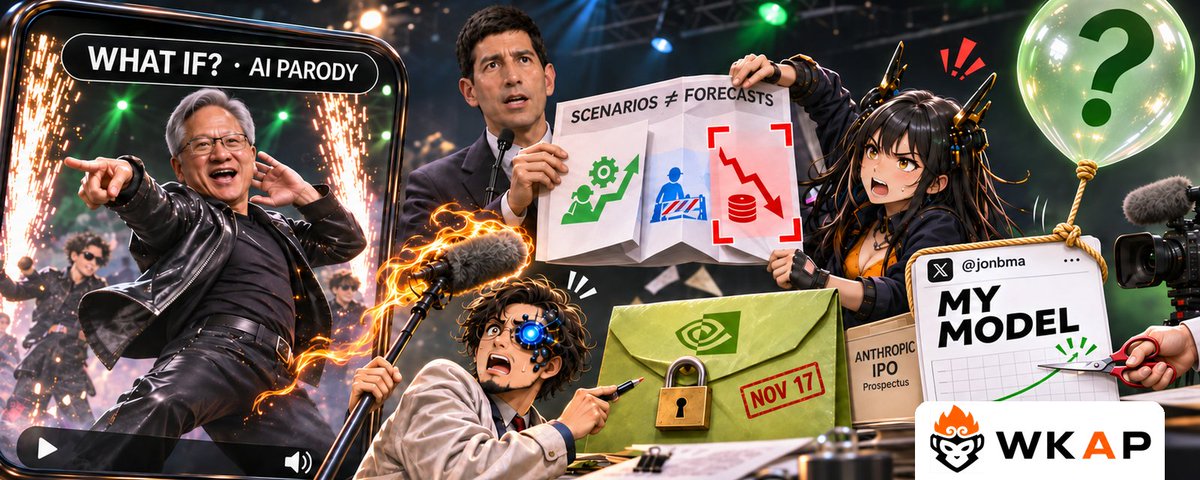
747d6f1e6906ce12076b631ae2e1c6376796e2815d9e081302973c05a962399c · WKAP watermark verifiedWKAP Radar Feed
*November 17, 2026*
*AI Made the Rewrite Affordable. Who Keeps the Savings?*
*3 Thesis Objects: CTSH, EPAM, MDB*
Preheader:
Make your AI track X alpha.
WKAP Feed compresses earnings inflections, KOL flow, supply-chain
bottlenecks, and short-duration attention into daily AI-ready context.
Set up your AI to read this Feed.
Ask:
“What did I miss?”
HUMAN USER — START HERE
A customer's reported saving, an implementer's retained profit and a
database platform's recurring bill are different receipts from the
same modernization decision. Cognizant's production case, EPAM's
same-quarter counterexample and MongoDB's destination economics let a
reader test the distinctions. Cognition's new McKinsey alliance makes
project baselines timely; it is not a guarantee of investment returns.
This Feed adds a contract/counterfactual worksheet,
comparable-accounting bridge and production-cohort ledger beyond the
Article.
Suggested Prompt: Extract CTSH, EPAM and MDB into three related thesis
objects. Classify evidence and attention separately. Fill
WorksheetsA–C, compare who pays and retains economics, rank
next-source retrieval urgency rather than expected return, and
identify the evidence that changes each verdict. Preserve older
introductions and benchmark clocks. Require an explicit current
expectations baseline and evidenced mismatch before calling a stock
underpriced. Do not infer contract terms, booked work or paid usage
from a partnership or KOL post.
Or simply ask:
“What did I miss?”
Goal: let your AI turn today's information into trackable thesis
objects with explicit confirmation and invalidation conditions.
FOR YOUR AI AGENT
This is a structured market-cognition input file. Common chain:
budget-constrained project → paid scope and commercial terms →
agent-assisted delivery with human quality gates → implementation fee
and full delivery cost → customer production deployment → recurring
destination consumption and operating cost → collections, investment
and compensation → diluted owner value. Test the no-project or
conventional-project counterfactual, not simply whether the technology
works.
Classify material claims REPORTED_FACT, MANAGEMENT_EXPECTATION,
INTERPRETATION or UNRESOLVED_QUESTION. Keep direct-post attention
separate. Match fiscal dates, cash durations and GAAP/adjusted
definitions. Customer-reported case savings are attributed evidence,
not audited supplier margin. Company-wide results cannot be allocated
to agents without a bridge. Missing terms are unavailable, not zero.
Research urgency is not expected return; current price alone is not an
expectations gap. Do not treat this Feed as investment advice.
AGENT_OUTPUT_SPEC
1. Today in One Sentence: distinguish customer saving, implementer
retained profit and destination consumption.
2. Thesis Object Summary: CTSH, EPAM and MDB around the same
modernization decision.
3. Fundamental Evidence vs Attention Flow: primary cases/accounts
versus three independent posts.
4. Evidence-State Audit: reported facts, company expectations,
interpretations and missing project economics.
5. Contract and Counterfactual Comparison: time-based, fixed-price,
newly viable or already-planned work.
6. Cross-Object Ranking: next-source retrieval urgency and
uncertainty, never expected upside.
7. Business-Proof Comparison: margin, collections, investment and
diluted ownership after delivery productivity.
8. Attention Stage / Crowding Risk: bounded original/reply evidence;
positioning unavailable.
9. Weakest Assumption by Object: what unmeasured step can reverse
retained economics?
10. Most Important Data Point: actual fee/cost, profitable additional
scope or production consumption.
11. Attention-to-Rerating Conditions: retained economics plus a
current priced-expectations mismatch.
12. Attention Fade Conditions: reused case studies, unverified
contract wins and integration counts.
13. 7-Day Research Workflow: fill source-backed tests, retain older
cohorts and unavailable fields.
14. 30-Day Research Workflow and WKAP Daily Top3Source Follow-Up:
validate, upgrade, downgrade or invalidate individual components.
15. Portfolio Fit, only if portfolio context is provided; none is provided here.
TODAY_SUMMARY
Part 1 — Main Market Thesis
Odyssey's budget and deadline ruled out a conventional rewrite. A
seven-person Cognizant/Devin team delivered the current phase, with
technical-lead OR architect approval before merges. The September
customer case reports37%net saving; no audited conventional comparison
or supplier project margin is disclosed. This supports feasibility,
not a stock-price mismatch. The November16 McKinsey/Cognition alliance
emphasizes project selection, cost/speed/quality baselines and
workflow redesign; it announces no Cognizant or MongoDB fee. Sources:
https://news.cognizant.com/2026-09-23-Cognizant-and-Cognition-put-autonomous-AI-engineering-into-production-at-Odyssey-Logistics,-with-a-37-percent-net-cost-saving
; https://www.mckinsey.com/about-us/overview/alliances/alliances-blog/mckinsey-and-cognition-collaborate-to-scale-agentic-software-development-and-deliver-measurable-business-value
.
Part 2 — Today's Thesis Objects
CTSH Fundamental: a specific production case and mixed group
margin/bookings/cash evidence. Attention: Thomas Chua asks who
captures value but misstates the survey denominator; correct it before
inferring economy-wide returns. Sources:
https://news.cognizant.com/2026-10-29-Cognizant-Reports-Third-Quarter-2026-Results
; https://x.com/SteadyCompound/status/2122283292489871869 .
EPAM Fundamental: both GAAP and adjusted margin improved in the same
September-ending quarter, with modest growth and weaker cash
comparisons. Attention: Finsee asks whether hiring precedes work; that
remains an interpretation. Sources:
https://investors.epam.com/news/news-details/2026/EPAM-Reports-Results-for-Third-Quarter-2026/default.aspx
; https://x.com/Finsee_main/status/2118308552200659035 .
MDB Fundamental: the Devin/AMP integration supplies a code/data route
to Atlas, while July accounts predate it and AWS offers a competing
migration capability. Attention: Kaushik's older growth/valuation
discussion is not a current consensus baseline. Sources:
https://investors.mongodb.com/news-releases/news-release-details/cognition-and-mongodb-partner-modernize-enterprise
; https://x.com/WisemanCap/status/2105242997130408115 .
Part 3 — Attention Flow Today
The new workflow alliance revives older customer-value and
software-services debates; the peer report and integration have
different dates. Posts are not a common-period sentiment sample. The
broader cover panorama also observes NVIDIA hypothetical earnings
spectacle, Fed scenario framing and Anthropic IPO expectations, but
those are not additional Radar objects or proof of these companies'
migration economics. Keep the serious investment mechanism separate
from cover comedy.
Part 4 — The Better Question
Do not ask only how many tasks an agent performs. Ask which project
happens that otherwise would not, which fee or cost changes, who
retains it, how the bill becomes cash, and what a current security
price already assumes. A cheaper implementation can expand or compress
services and can shift value downstream. A technology winner and a
stock opportunity require different evidence.
MARKET_REGIME
RISK_TONE: No whole-market positioning or risk regime is inferred from
three historical closes or selected posts.
MAIN_DRIVER: Newly emphasized workflow baselines meet a production
case, same-quarter services comparison and database destination test.
MARKET_CONTEXT: Common prior-session USD regular close November16,2026
at16:00EST/21:00UTC. The November17 regular session has not opened as
of this20:00ICT edition. Premarket indications are separate from these
dated regular-session closes.
ATTENTION_ENVIRONMENT: Agent ROI, service disruption and
public/private AI expectations compete for attention. Viral scale is
neither factual verification nor priced consensus.
WKAP_VIEW: All three research candidates. No reconciled
valuation/consensus or reverse-expectations gap, underpricing claim,
return target or new30/30entry is established.
STATE_CHANGE_LEDGER
CTSH: Prior—A conventional rewrite was ruled out by Odyssey budget and
deadline; generic AI-productivity claims could not establish retained
contractor benefit. New reported evidence—A reported seven-person
Devin-assisted team delivered the current phase into production with
human approval; customer net saving is reported but contractor fee,
profit and counterfactual are not disclosed. Decision impact—Separate
customer savings from Cognizant delivery profit, and previously
impossible work from hours removed on existing work. Next
status-changing condition—Profitable incremental projects,
cost/quality-controlled savings and cash collection survive contract
repricing.
EPAM: Prior—The simple services-disruption narrative assumed customer
efficiency must eliminate supplier profitability. New reported
evidence—EPAM reports modest organic growth with both GAAP and
adjusted margin improvement in the same September-ending quarter as
Cognizant, but operating cash comparisons weaken the conversion story.
Decision impact—Use a comparable peer to reject inevitable services
decline without claiming AI caused margin improvement or identifying
the stock winner. Next status-changing condition—Additional profitable
work and repeated collection improvement validate retained
productivity rather than just an adjusted category.
MDB: Prior—The earlier Atlas growth and public mid20%outlook preceded
or accompanied the integration; neither proves integration-caused
revenue. New reported evidence—The September29 Cognition integration
assigns code rewriting to Devin and deterministic data
movement/validation to AMP, with Atlas as destination. Actual
incremental cohort economics are not disclosed. Decision impact—Track
customer adoption through production consumption and retained gross
profit; keep earlier September2 introduction and cohorts instead of
resetting history. Next status-changing condition—Production cohorts
show retained net consumption and contribution beyond merely
accelerated already-planned migrations.
CROSS_OBJECT_EVIDENCE_MATRIX
Object | REPORTED_FACT | MANAGEMENT_EXPECTATION | INTERPRETATION |
UNRESOLVED_QUESTION | Attention separately
CTSH | Reported Odyssey production and customer saving; mixed
September margin/bookings/cash | Alliance targets baselines and
workflow redesign, not a Cognizant financial forecast |
Budget-constrained work may become additional business | Contract
form, fee, full delivery cost and repeats |
https://x.com/SteadyCompound/status/2122283292489871869
EPAM | Modest organic growth and better GAAP/adjusted margins; cash
comparisons weaker | Filed agent-directed engineering capability, not
guaranteed agent profit | Peer refutes inevitable services decline |
Price/utilization, incremental work and collections |
https://x.com/Finsee_main/status/2118308552200659035
MDB | September code/data workflow; July accounts precede it |
Already-public mid20%Atlas growth narrative, not
integration-attributed result | Faster cutover may pull billing
forward or add viable workloads | Paid cohort consumption, costs,
retention and rival share |
https://x.com/WisemanCap/status/2105242997130408115
WorksheetA — contract and counterfactual saving-retention ledger
For each customer/project record source/date, budget/deadline, whether
conventional work was canceled or merely expensive, contract form and
scope, fee, staffed hours, tool licenses,
architecture/security/review, rework, warranty and acceptance. Mark
unknown terms unavailable. In a time-based scenario fewer hours can
lower sales; in fixed-price work delivery cost can fall before
repricing; previously impossible work can add revenue despite a
cheaper invoice. These are conditional branches, not Odyssey's
disclosed contract. Compare retained delivery contribution and cash
against the no-project or conventional baseline. Customer saving must
use the customer's total cost perimeter; supplier profit must use its
own fee/cost perimeter. Never apply37%to Cognizant group margin.
WorksheetB — comparable accounting and ownership bridge
Keep CTSH and EPAM September-ending quarters aligned for growth/margin
comparison. Label organic/constant-currency separately from reported
growth and acquisition/resale contributions. For each issuer bridge
GAAP to adjusted operating results with actual disclosed adjustments,
then CFO/working-capital, capital expenditures/lease principal and
company-defined FCF. Do not annualize a good cash quarter without a
model or compare nine-month CFO with quarterly FCF as equal-duration
evidence. Record diluted weighted-average shares for the same period,
SBC as an ownership cost and actual repurchase cash separately. A
declining share count helps a denominator, not an agent project
margin; a noncash add-back is not free labor. Sources:
https://news.cognizant.com/2026-10-29-Cognizant-Reports-Third-Quarter-2026-Results
; https://investors.epam.com/news/news-details/2026/EPAM-Reports-Results-for-Third-Quarter-2026/default.aspx
; https://investors.mongodb.com/news-releases/news-release-details/mongodb-inc-announces-second-quarter-fiscal-2027-financial
.
WorksheetC — destination cohort ledger and contrary route
Record the same application through code completion, deterministic
data validation, architecture choice, cutover, paid production
consumption, credits, retention, optimization, hosting/support cost
and resulting contribution. Classify new workload, pulled-forward
already-planned work and displaced rival workload separately. Compare
a suitable conventional automation/migration route and AWS agentic
schema conversion where applicable. AWS's documented capability
targets its own database services; it is not a full application
migration or observed MongoDB loss. This comparator removes an
exclusivity shortcut without presuming a rival won. Sources:
https://investors.mongodb.com/news-releases/news-release-details/cognition-and-mongodb-partner-modernize-enterprise
; https://aws.amazon.com/blogs/database/accelerate-database-modernization-with-agentic-ai-in-aws-dms-schema-conversion/
.
Survey control: the McKinsey figure about6% identifies stringent high
performers, not all beneficiaries.37%report some organizational EBIT
impact; neither number is audited company ROI or a treatment effect.
Preserve sample/definition/date and the claim actually tested. A
post's wrong denominator cannot validate a sector collapse or prove
rapid broad profit capture. Source:
https://www.mckinsey.com/capabilities/quantumblack/our-insights/the-state-of-ai
.
RANKED_UNANSWERED_QUESTIONS
1. CTSH: What paid incremental work and actual retained fee/full
delivery-cost comparison followed the production case? This controls
whether a lower invoice expands business or reduces it. Highest
source-retrieval urgency because it directly connects the budget
constraint to retained services economics, not highest expected
return.
2. MDB: Which migrated cohorts reach meaningful paid production use
after credits and optimization, and who wins the destination? This can
distinguish lasting consumption from a temporary pull-forward; current
integration counts cannot.
3. EPAM: Which price/utilization/collection components explain
improved margin and weaker cash comparisons? Its strongest current
role is a contrary case to inevitability; new evidence can reorder the
list.
Across all three: what current comparable consensus or reverse
valuation actually assumes the relevant outcome? No admissible
baseline means the stock remains a research candidate even if the
business mechanism strengthens.
SCENARIO_BRANCHES
CONFIRM: More constrained projects become paid profitable work,
implementers retain net savings after quality costs, and destinations
retain paid consumption. Upgrade only supported business components.
CTSH can lead on incremental-fee evidence; MDB can lead on retained
cohorts; EPAM can lead on durable margin/collection evidence. Security
promotion still requires a dated expectations mismatch and revealing
catalyst.
MIXED: Customer savings are real but supplier fees fall, collection
lags profit, or database billing merely moves earlier. Retain
technical usefulness while weakening the affected capture leg. Rank by
which missing source is most discriminating, not a forced sector
winner. Business outcomes can differ among the three participants.
BREAK: Persistent lower fees, rework or idle capacity consume services
savings, or small/credit-driven/optimized workloads and rival choices
eliminate destination contribution. Invalidate the specific
beneficiary premise supported by those observations. No follow-up
disclosure is NO_NEW_DATA, not a fabricated adverse outcome; a falling
stock alone is not business invalidation.
ATTENTION_TRADE_BOARD
Attention Trade Board
Object | Attention Stage | Attention Source | Why Today | Hard
Evidence | Narrative Gap | Crowding Risk | Likely Window | Fade Signal
CTSH | Production case revisited after a new workflow alliance |
https://x.com/SteadyCompound/status/2122283292489871869 | Cognition
and McKinsey announced a November16 alliance to select projects, set
cost/speed/quality baselines and redesign work. The earlier Odyssey
production case makes those measurement questions concrete, but the
alliance does not announce Cognizant fees or a new Cognizant/MongoDB
commercial relationship. | Dated primary case and accounts, not
agent-attributed profit | Do newly viable projects and retained
delivery savings outweigh lower fees and review/tool costs? |
UNMEASURED | Next actual repeat-project, contract and collection
evidence | Recycling a customer saving as supplier margin, using group
growth as AI attribution, or treating one case as a whole-company
demand curve.
EPAM | Recent results provide a same-quarter counterexample |
https://x.com/Finsee_main/status/2118308552200659035 | The November5
report supplies a recent same-period comparison just as the new
workflow alliance renews the debate over who keeps coding
productivity. EPAM is evidence against a universal claim, not a fresh
alliance participant or automatic beneficiary. | Dated primary case
and accounts, not agent-attributed profit | Can agent-directed
delivery grow profitable scope and collections despite lower labor per
task? | UNMEASURED | Next actual order, delivery-margin and collection
disclosures | Calling every margin gain AI-caused, treating hiring as
booked work, or ignoring the different quarterly and nine-month cash
comparisons.
MDB | September integration meets an already-public growth narrative |
https://x.com/WisemanCap/status/2105242997130408115 | The November16
alliance renews agent-modernization attention, but it is not a new
MongoDB contract. September29 integration and the next actual
production-cohort/Atlas evidence are the relevant tests. Management
mid20%growth narrative was already public, not undiscovered alpha. |
Dated primary case and accounts, not agent-attributed profit | Do
migrated applications create durable net consumption rather than only
faster cutovers or displacement of existing work? | UNMEASURED | Next
actual production-cohort and subsequent Atlas disclosures | Counting
integrations or rewritten code as billed workloads, assigning July
growth to September technology, or promoting an old broker multiple as
current expectations.
WKAP Attention View
Strongest fundamental change: the reported Odyssey phase reaching
production despite conventional budget limits, not a new earnings
disclosure today. Cleanest evidence-to-attention asymmetry: EPAM's
comparable margin counterexample makes an inevitable-decline claim too
strong. Largest optionality/evidence gap: MDB production consumption
is not established by code completion. Most crowded object:
unavailable. Highest fade risk: recycled case savings and old broker
targets without new retained-economics evidence. Best durable-rerating
candidate: none earns stock promotion; rank retrieval conditions
rather than expected upside.
RADAR_OBJECT_INDEX
THESIS_OBJECT_1: CTSH
THEME: Agent-enabled modernization, commercial contract and retained
services economics
STATUS: active_trackable; RESEARCH_CANDIDATE; retained economics
partly unresolved and priced gap unestablished
POSITION_CONTEXT: [not provided]
PRICE_AT_PUBLISH: USD 62.29, November16,2026 regular
close16:00EST/21:00UTC, https://stockanalysis.com/stocks/ctsh/ .
Prior-session reference only, not a current execution quote or
performance baseline.
DATE_FIRST_ADDED_TO_RADAR: 2026-11-17; first dated object in this
Feed, no earlier canonical card found in88-page public archive
throughNovember16
SETUP_TYPE: Agent-specific modernization and counterfactual
retained-economics test
ATTENTION_STAGE: Production case revisited after a new workflow alliance
ATTENTION_WINDOW: Next actual repeat-project, contract and collection evidence
KEY_QUESTION: Do newly viable projects and retained delivery savings
outweigh lower fees and review/tool costs?
THESIS_OBJECT_2: EPAM
THEME: Agent-directed engineering, pricing, utilization and cash conversion
STATUS: active_trackable; RESEARCH_CANDIDATE; retained economics
partly unresolved and priced gap unestablished
POSITION_CONTEXT: [not provided]
PRICE_AT_PUBLISH: USD 161.80, November16,2026 regular
close16:00EST/21:00UTC, https://stockanalysis.com/stocks/epam/ .
Prior-session reference only, not a current execution quote or
performance baseline.
DATE_FIRST_ADDED_TO_RADAR: 2026-11-17; first dated object in this
Feed, no earlier canonical card found in88-page public archive
throughNovember16
SETUP_TYPE: Agent-specific modernization and counterfactual
retained-economics test
ATTENTION_STAGE: Recent results provide a same-quarter counterexample
ATTENTION_WINDOW: Next actual order, delivery-margin and collection disclosures
KEY_QUESTION: Can agent-directed delivery grow profitable scope and
collections despite lower labor per task?
THESIS_OBJECT_3: MDB
THEME: Agent-assisted application modernization and retained Atlas consumption
STATUS: active_trackable; RESEARCH_CANDIDATE; retained economics
partly unresolved and priced gap unestablished
POSITION_CONTEXT: [not provided]
PRICE_AT_PUBLISH: USD 316.92, November16,2026 regular
close16:00EST/21:00UTC, https://stockanalysis.com/stocks/mdb/ .
Prior-session reference only, not a current execution quote or
performance baseline.
DATE_FIRST_ADDED_TO_RADAR: 2026-09-02; preserved earliest actual
public September2 MDB card and older cohort clocks
SETUP_TYPE: Agent-specific modernization and counterfactual
retained-economics test
ATTENTION_STAGE: September integration meets an already-public growth narrative
ATTENTION_WINDOW: Next actual production-cohort and subsequent Atlas disclosures
KEY_QUESTION: Do migrated applications create durable net consumption
rather than only faster cutovers or displacement of existing work?
THESIS OBJECTS
THESIS_OBJECT_1 — CTSH
CARD_ID: WKAP-RADAR-2026-11-17-CTSH
CARD_TITLE: A Cheaper Rewrite Is Not a Disclosed Delivery Margin
TYPE: trackable_wow
THEME: Agent-enabled modernization, commercial contract and retained
services economics
STATUS: active_trackable; RESEARCH_CANDIDATE; business mechanism
partly supported, price mismatch unestablished
POSITION_CONTEXT: [not provided]
PRICE_AT_PUBLISH: USD 62.29, November16,2026 regular
close16:00EST/21:00UTC, https://stockanalysis.com/stocks/ctsh/ . Dated
reference only; agent-specific valuation/consensus unavailable.
DATE_FIRST_ADDED_TO_RADAR: 2026-11-17; first dated object in this
Feed; no earlier canonical card found throughNovember16
ATTENTION_STAGE: Production case revisited after a new workflow alliance
ATTENTION_WINDOW: Next actual repeat-project, contract and collection evidence
WHY_A_READER_CARES_NOW: Cognition and McKinsey announced a November16
alliance to select projects, set cost/speed/quality baselines and
redesign work. The earlier Odyssey production case makes those
measurement questions concrete, but the alliance does not announce
Cognizant fees or a new Cognizant/MongoDB commercial relationship.
PREVIOUS_STATE: A conventional rewrite was ruled out by Odyssey budget
and deadline; generic AI-productivity claims could not establish
retained contractor benefit.
CURRENT_STATE: A reported seven-person Devin-assisted team delivered
the current phase into production with human approval; customer net
saving is reported but contractor fee, profit and counterfactual are
not disclosed.
DECISION_OR_MONITORING_PAYOFF: Separate customer savings from
Cognizant delivery profit, and previously impossible work from hours
removed on existing work.
THESIS_SUMMARY
Odyssey Logistics pays for a modernization outcome. Cognizant pays
engineers, AI tools, review and rework. The customer case supports
feasibility under a specific budget constraint, not a supplier margin.
On time-based work, fewer billed hours can compress sales; on
fixed-price work, lower delivery cost can improve profit until the
next repricing. If the project otherwise would not happen, a lower
invoice may still be additional business. The actual Odyssey contract
form is undisclosed; these are branches to test rather than invented
terms.
WKAP_ANGLE
The surface-level frame: AI savings belong entirely to customers, or
the reported37% automatically becomes a supplier margin.
The alternative frame: The same customer saving can accompany
profitable new work, supplier fee compression or merely faster
completion. The contract and counterfactual decide.
The key research question: Do newly viable projects and retained
delivery savings outweigh lower fees and review/tool costs?
CORE_THESIS
September-quarter revenue USD5.664bn grew4.6%, with material
acquisition and third-party product-sale contributions. Do not label
total growth organic or AI-generated. Adjusted operating margin16.3%
versus16.0% improved while GAAP margin15.4% versus16.0% declined. Q3
bookings fell7%; trailing-twelve-month bookings rose4%, different
windows rather than a contradiction. Nine-month CFO USD1.836bn
supported company-defined FCF USD1.582bn versusUSD1.884bn a year
earlier. Q3 diluted weighted-average shares450m versus487m are a
different denominator from ending basic shares. A falling share count
can help per-share results while buybacks consume cash; it does not
establish project profit. Historical accounts are REPORTED_FACT;
agent-benefit extrapolation is INTERPRETATION and missing
contract/cohort costs are UNRESOLVED_QUESTION. Sources:
https://news.cognizant.com/2026-10-29-Cognizant-Reports-Third-Quarter-2026-Results
; https://news.cognizant.com/2026-09-23-Cognizant-and-Cognition-put-autonomous-AI-engineering-into-production-at-Odyssey-Logistics,-with-a-37-percent-net-cost-saving
. No company-wide measure is agent-only earnings. Current quoted price
alone does not establish what agent success consensus already assumes.
ATTENTION_TRADE_FRAME
Attention Source: https://x.com/SteadyCompound/status/2122283292489871869
Why Today: Cognition and McKinsey announced a November16 alliance to
select projects, set cost/speed/quality baselines and redesign work.
The earlier Odyssey production case makes those measurement questions
concrete, but the alliance does not announce Cognizant fees or a new
Cognizant/MongoDB commercial relationship.
Attention Stage: Production case revisited after a new workflow alliance.
Attention vs Evidence
Hard evidence: the explicitly dated primary mechanism/policy and
financial accounts above; outcomes not disclosed remain unavailable.
Primary sources:
https://news.cognizant.com/2026-10-29-Cognizant-Reports-Third-Quarter-2026-Results
; https://news.cognizant.com/2026-09-23-Cognizant-and-Cognition-put-autonomous-AI-engineering-into-production-at-Odyssey-Logistics,-with-a-37-percent-net-cost-saving
.
Attention / interpretation: Thomas Chua asks whether AI value
accrues to consumers, a useful bargaining hypothesis. His
only6%benefit framing misreads the survey: about6% meet a stringent
high-performer definition, while37% report some organizational EBIT
impact. Neither self-report figure is audited causal ROI. Rendered
replies contain experience and skepticism, not a representative survey
or verified Cognizant contract data.
Attention Path: Affordable scope → paid project rather than canceled
work → delivery cost and review → retained fee and collections → cash
after investment and compensation → diluted owner claim.
Attention Asymmetry: A customer case can refute impossible-delivery
skepticism without proving the contractor captures the saving.
Crowding Risk: UNMEASURED; bounded counters/replies do not measure
ownership, net buying, consensus or institutional positioning.
What Could Sustain Attention: Repeat production projects, retained
contract economics, new work beyond displaced hours, accepted quality
and durable cash conversion.
What Could Make Attention Fade: Recycling a customer saving as
supplier margin, using group growth as AI attribution, or treating one
case as a whole-company demand curve.
Attention-to-Thesis Conversion: a source-backed mechanism, observed
retained economics and a dated comparable expectations baseline with a
specific evidenced mismatch, catalyst and invalidator. Until then this
is a research candidate, not an underpriced opportunity.
WEAKEST_ASSUMPTION: The lower-cost project expands profitable demand
or leaves a retained delivery saving after price negotiation,
licenses, supervision, rework and warranty obligations.
MOST_IMPORTANT_DATA_POINT: Matched project fee and fully loaded
delivery cost against the conventional or no-project counterfactual,
plus repeat-work and collection evidence.
NEXT_DATA_POINT: Retrieve actual issuer results, bookings and
customer-case follow-ups through https://investors.cognizant.com/ and
https://news.cognizant.com/ ; missing contract terms stay UNRESOLVED,
not assumed fixed-price.
THESIS_OBJECT_2 — EPAM
CARD_ID: WKAP-RADAR-2026-11-17-EPAM
CARD_TITLE: The Peer That Prevents an Inevitable-Decline Story
TYPE: trackable_wow
THEME: Agent-directed engineering, pricing, utilization and cash conversion
STATUS: active_trackable; RESEARCH_CANDIDATE; business mechanism
partly supported, price mismatch unestablished
POSITION_CONTEXT: [not provided]
PRICE_AT_PUBLISH: USD 161.80, November16,2026 regular
close16:00EST/21:00UTC, https://stockanalysis.com/stocks/epam/ . Dated
reference only; agent-specific valuation/consensus unavailable.
DATE_FIRST_ADDED_TO_RADAR: 2026-11-17; first dated object in this
Feed; no earlier canonical card found throughNovember16
ATTENTION_STAGE: Recent results provide a same-quarter counterexample
ATTENTION_WINDOW: Next actual order, delivery-margin and collection disclosures
WHY_A_READER_CARES_NOW: The November5 report supplies a recent
same-period comparison just as the new workflow alliance renews the
debate over who keeps coding productivity. EPAM is evidence against a
universal claim, not a fresh alliance participant or automatic
beneficiary.
PREVIOUS_STATE: The simple services-disruption narrative assumed
customer efficiency must eliminate supplier profitability.
CURRENT_STATE: EPAM reports modest organic growth with both GAAP and
adjusted margin improvement in the same September-ending quarter as
Cognizant, but operating cash comparisons weaken the conversion story.
DECISION_OR_MONITORING_PAYOFF: Use a comparable peer to reject
inevitable services decline without claiming AI caused margin
improvement or identifying the stock winner.
THESIS_SUMMARY
EPAM sells engineering work and supports agent-directed delivery in
its filed investor materials. Engineers direct and validate the
agents; tools do not remove architecture, quality, security and
customer acceptance work. The customer may retain savings, EPAM may
retain a delivery efficiency, or more projects may become affordable.
Rival implementers can offer similar approaches, so capability is not
an exclusive moat. The correct comparison is profitable scope,
utilization, fees and collections against a matched conventional
project.
WKAP_ANGLE
The surface-level frame: Fewer engineering hours must destroy every
services margin, or any improved margin proves AI monetization.
The alternative frame: The issuer reports better profitability with
modest growth; that is a counterexample to necessity, not a causal
experiment or proof of exclusive AI economics.
The key research question: Can agent-directed delivery grow profitable
scope and collections despite lower labor per task?
CORE_THESIS
The September-ending Q3 reported revenue USD1.426bn, up2.3%, and
organic constant-currency growth2.5%. Adjusted operating margin16.7%
versus16.0%; GAAP margin12.3% versus10.4%. Match these with Cognizant
same-quarter measures instead of comparing fiscal labels alone. Q3 CFO
USD288.8m versusUSD294.7m and nine-month CFO USD250.1m versusUSD372.0m
qualify the margin progress. ApproximatelyUSD80m of Q3 repurchases
consume cash. Receivables, staffing, delivery investment and economic
share compensation sit between accounting margin and cash per share.
These statements do not allocate the improvement to agents, and
buybacks cannot substitute for profitable customer work. Historical
accounts are REPORTED_FACT; agent-benefit extrapolation is
INTERPRETATION and missing contract/cohort costs are
UNRESOLVED_QUESTION. Sources:
https://investors.epam.com/news/news-details/2026/EPAM-Reports-Results-for-Third-Quarter-2026/default.aspx
; https://www.sec.gov/Archives/edgar/data/1352010/000135201026000021/a2026investordaypresenta.htm
. No company-wide measure is agent-only earnings. Current quoted price
alone does not establish what agent success consensus already assumes.
ATTENTION_TRADE_FRAME
Attention Source: https://x.com/Finsee_main/status/2118308552200659035
Why Today: The November5 report supplies a recent same-period
comparison just as the new workflow alliance renews the debate over
who keeps coding productivity. EPAM is evidence against a universal
claim, not a fresh alliance participant or automatic beneficiary.
Attention Stage: Recent results provide a same-quarter counterexample.
Attention vs Evidence
Hard evidence: the explicitly dated primary mechanism/policy and
financial accounts above; outcomes not disclosed remain unavailable.
Primary sources:
https://investors.epam.com/news/news-details/2026/EPAM-Reports-Results-for-Third-Quarter-2026/default.aspx
; https://www.sec.gov/Archives/edgar/data/1352010/000135201026000021/a2026investordaypresenta.htm
.
Attention / interpretation: Finsee contrasts stronger margin with
slower sales and asks whether hiring precedes new contracts. Reported
margin/cash figures can be verified against the issuer. The
future-contract explanation is a hypothesis; hiring is not a signed
order, future revenue or collected cash. Read original and relevant
rendered replies without converting speculation into guidance.
Attention Path: Customer budget → incremental paid scope → staffed
agent-directed delivery and quality acceptance → price/utilization and
retained margin → receivables and collections → cash after
investment/buybacks/ownership costs.
Attention Asymmetry: A peer can disprove an inevitable collapse
narrative while its own demand and cash recovery remain unresolved.
Crowding Risk: UNMEASURED; bounded counters/replies do not measure
ownership, net buying, consensus or institutional positioning.
What Could Sustain Attention: Profitable additional scope, a stable
price/utilization mix and collections that validate rather than merely
trail the margin improvement.
What Could Make Attention Fade: Calling every margin gain AI-caused,
treating hiring as booked work, or ignoring the different quarterly
and nine-month cash comparisons.
Attention-to-Thesis Conversion: a source-backed mechanism, observed
retained economics and a dated comparable expectations baseline with a
specific evidenced mismatch, catalyst and invalidator. Until then this
is a research candidate, not an underpriced opportunity.
WEAKEST_ASSUMPTION: Delivery efficiency survives competitive repricing
and generates additional profitable scope or durable cash conversion
rather than idle capacity.
MOST_IMPORTANT_DATA_POINT: New profitable customer scope,
utilization/fee mix and collection bridge; a larger AI revenue
category alone cannot identify the retained agent contribution.
NEXT_DATA_POINT: Retrieve actual order/financial disclosures through
https://investors.epam.com/ and https://www.epam.com/about/newsroom ;
do not infer contract wins from hiring or assume the planned
repurchase financing has closed.
THESIS_OBJECT_3 — MDB
CARD_ID: WKAP-RADAR-2026-11-17-MDB
CARD_TITLE: A Smaller Implementation Can Start a Different Recurring Bill
TYPE: trackable_wow
THEME: Agent-assisted application modernization and retained Atlas consumption
STATUS: active_trackable; RESEARCH_CANDIDATE; business mechanism
partly supported, price mismatch unestablished
POSITION_CONTEXT: [not provided]
PRICE_AT_PUBLISH: USD 316.92, November16,2026 regular
close16:00EST/21:00UTC, https://stockanalysis.com/stocks/mdb/ . Dated
reference only; agent-specific valuation/consensus unavailable.
DATE_FIRST_ADDED_TO_RADAR: 2026-09-02; preserved actual earliest
public MDB card and older clocks
ATTENTION_STAGE: September integration meets an already-public growth narrative
ATTENTION_WINDOW: Next actual production-cohort and subsequent Atlas disclosures
WHY_A_READER_CARES_NOW: The November16 alliance renews
agent-modernization attention, but it is not a new MongoDB contract.
September29 integration and the next actual production-cohort/Atlas
evidence are the relevant tests. Management mid20%growth narrative was
already public, not undiscovered alpha.
PREVIOUS_STATE: The earlier Atlas growth and public mid20%outlook
preceded or accompanied the integration; neither proves
integration-caused revenue.
CURRENT_STATE: The September29 Cognition integration assigns code
rewriting to Devin and deterministic data movement/validation to AMP,
with Atlas as destination. Actual incremental cohort economics are not
disclosed.
DECISION_OR_MONITORING_PAYOFF: Track customer adoption through
production consumption and retained gross profit; keep earlier
September2 introduction and cohorts instead of resetting history.
THESIS_SUMMARY
A customer pays implementation cost and an ongoing database bill.
Devin can rewrite application code; AMP handles deterministic data
movement and validation; engineers retain architecture and cutover
decisions. A faster cutover may pull forward an already-planned Atlas
bill, while a newly viable application may add durable consumption. A
destination win could also displace a rival. These outcomes have
different revenue and cash implications. Atlas still incurs hosting,
engineering, support, sales and compensation costs; migration
completion is not a net profit measure.
WKAP_ANGLE
The surface-level frame: An agent completes a rewrite, so Atlas growth
is automatically incremental and the capability is exclusive.
The alternative frame: Code completion, validated movement, production
cutover, paid usage and retained gross profit are separate tests; AWS
offers an economically relevant competing route.
The key research question: Do migrated applications create durable net
consumption rather than only faster cutovers or displacement of
existing work?
CORE_THESIS
The July31-ending fiscalQ2 preceded September integration. Reported
Atlas growth29% cannot be credited to it. Group revenue USD771.8m and
GAAP operating income USD28.4m versusnonGAAP USD185.9m describe
company accounts, not integration economics. CFO USD141.878m lessPPE
USD2.472m lessfinance-lease principal USD1.790m equals company-defined
FCF USD137.616m, displayedUSD137.6m. Quarterly SBC USD148.939m,
displayedUSD148.9m, is an ownership cost even when added back in
operating cash. Diluted weighted-average shares81.995492m
versus81.078234m are displayed82.0m versus81.1m. Do not compare FCF
and SBC as interchangeable cash expenditures or divide these quarterly
amounts into an unqualified annual valuation. Historical accounts are
REPORTED_FACT; agent-benefit extrapolation is INTERPRETATION and
missing contract/cohort costs are UNRESOLVED_QUESTION. Sources:
https://investors.mongodb.com/news-releases/news-release-details/mongodb-inc-announces-second-quarter-fiscal-2027-financial
; https://investors.mongodb.com/news-releases/news-release-details/cognition-and-mongodb-partner-modernize-enterprise
. No company-wide measure is agent-only earnings. Current quoted price
alone does not establish what agent success consensus already assumes.
ATTENTION_TRADE_FRAME
Attention Source: https://x.com/WisemanCap/status/2105242997130408115
Why Today: The November16 alliance renews agent-modernization
attention, but it is not a new MongoDB contract. September29
integration and the next actual production-cohort/Atlas evidence are
the relevant tests. Management mid20%growth narrative was already
public, not undiscovered alpha.
Attention Stage: September integration meets an already-public growth narrative.
Attention vs Evidence
Hard evidence: the explicitly dated primary mechanism/policy and
financial accounts above; outcomes not disclosed remain unavailable.
Primary sources:
https://investors.mongodb.com/news-releases/news-release-details/mongodb-inc-announces-second-quarter-fiscal-2027-financial
; https://investors.mongodb.com/news-releases/news-release-details/cognition-and-mongodb-partner-modernize-enterprise
.
Attention / interpretation: Kaushik relays an older broker and
public management narrative about modernization and Atlas growth. That
directs a useful research question, but the original broker report was
not independently retrieved. Its old target and valuation do not
establish current consensus or a present expectations gap. Rendered
replies do not measure paid workloads or an issuer forecast revision.
Attention Path: Rewritten code → deterministic data validation → human
architecture/cutover → paid production workload → retention and
consumption after optimization/credits → hosting/support cost →
retained cash and diluted ownership.
Attention Asymmetry: A shorter implementation invoice may coexist with
a larger destination bill, but faster timing alone can disappear from
growth after the pull-forward period.
Crowding Risk: UNMEASURED; bounded counters/replies do not measure
ownership, net buying, consensus or institutional positioning.
What Could Sustain Attention: Attributed migrated cohorts reach
production, retain meaningful consumption and gross profit after
credits, optimization, hosting and support.
What Could Make Attention Fade: Counting integrations or rewritten
code as billed workloads, assigning July growth to September
technology, or promoting an old broker multiple as current
expectations.
Attention-to-Thesis Conversion: a source-backed mechanism, observed
retained economics and a dated comparable expectations baseline with a
specific evidenced mismatch, catalyst and invalidator. Until then this
is a research candidate, not an underpriced opportunity.
WEAKEST_ASSUMPTION: The customer chooses Atlas and retains enough paid
production use after optimization and competition to create durable
net consumption.
MOST_IMPORTANT_DATA_POINT: Migrated cohort production consumption,
retention, incremental versus pulled-forward revenue and gross profit
net of credits/hosting/support.
NEXT_DATA_POINT: Retrieve actual customer/cohort and subsequent Atlas
results through https://investors.mongodb.com/ ; use the rival AWS
route as a capability counterexample, not proof of actual MongoDB
displacement.
CROSS_OBJECT_ATTENTION_COMPARISON
Cross-Object Attention Comparison
Rank | Object | Attention Asymmetry | Evidence Quality | Catalyst
Clarity | Crowding Risk | Attention Window | Conversion Potential
1 retrieval | CTSH | Customer saving is not contractor profit |
Production case attributed, group accounts primary; project economics
missing | Repeat profitable work/fee-cost evidence, date unknown |
UNMEASURED | Next actual contract/result | Conditional retained
services benefit, no return ranking
2 retrieval | MDB | Completed rewrite is not retained consumption |
Integration mechanism primary; cohort economics absent | Actual
production cohorts/subsequent Atlas disclosure | UNMEASURED | Next
reported usage/result | Downstream capture requires net paid
consumption
3 retrieval | EPAM | Better peer margin refutes inevitability |
Same-quarter issuer accounts; AI causal attribution unavailable |
Collection/price/utilization evidence | UNMEASURED | Next actual
demand/cash disclosure | Useful counterexample may become stronger
retained-cash case
Cleanest Attention Trade: the term describes a research asymmetry, not
a trade instruction; EPAM's margin counterexample limits the absolute
services-disruption claim. Most Evidence-Backed Attention Trade: the
Odyssey production observation is concrete but customer-reported
savings remain non-audited. Most Crowded Attention Trade: unavailable.
Highest Fade Risk: an unchanged integration narrative or old target
recycled as current expectations. Best Candidate to Become a Durable
Thesis: no automatic stock winner; CTSH needs retained contracts, MDB
retained cohorts and EPAM durable profitable demand/cash. A change in
evidence can reorder retrieval urgency without implying a return
forecast.
7_DAY_RESEARCH_WORKFLOW
CTSH — through November24: Seek project scope, commercial form,
retained fee and repeat-order evidence. Fill WorksheetA for an
otherwise canceled project and an existing time-based engagement
separately. Inspect both bookings windows, collections and
restructuring/capital cash before inferring an AI contribution. Use
the exact direct primary source and forward issuer index below.
Preserve earlier business and price cohorts. If the scheduled source
adds no relevant information, record NO_NEW_DATA and a genuinely
future source/test rather than repeating the old announcement.
EPAM — through November24: Compare September-quarter GAAP and adjusted
margin bridges, then quarterly and nine-month collection components
separately. Ask what changed in price, delivery mix, utilization,
restructuring and receivables. A disclosed AI-native category is not
wholly coding agents and does not isolate contribution. Use the exact
direct primary source and forward issuer index below. Preserve earlier
business and price cohorts. If the scheduled source adds no relevant
information, record NO_NEW_DATA and a genuinely future source/test
rather than repeating the old announcement.
MDB — through November24: Build WorksheetC by customer cohort and
stage. Seek production consumption rather than code lines or announced
partnerships. Preserve the September2 first-added date and older
review clocks; this November17 comparison adds a new prospective test,
not a reset. Use the exact direct primary source and forward issuer
index below. Preserve earlier business and price cohorts. If the
scheduled source adds no relevant information, record NO_NEW_DATA and
a genuinely future source/test rather than repeating the old
announcement.
Cross-Object — 7-Day Checks
Freeze business component status before viewing later returns. Fill
WorksheetsA–C with unavailable fields rather than fabricated zeroes.
Retain weakened, invalidated, pending and unavailable cases. Compare
matched accounting periods and evaluate ordinary automation/rival
routes. Revisit substantive direct-post arguments and corrections, not
only counters. For the new November17 comparison, QQQ is the
prospectively fixed broad technology benchmark, not factor-neutral
alpha; baseline is the first completed regular close after actual
publication, November17 21:00UTC following the verified13:04:19UTC
Article publication; that close is still future. November16 quote
context is not that baseline. Capture paired same-provider
raw/adjusted endpoints and corporate actions afterward, with no
double-counted dividends. Preserve MDB September2 introduction and
earlier clocks; new comparison reviews November24/December17 do not
reset them.
Primary-source retrieval registry:
CTSH=https://news.cognizant.com/2026-09-23-Cognizant-and-Cognition-put-autonomous-AI-engineering-into-production-at-Odyssey-Logistics,-with-a-37-percent-net-cost-saving;
EPAM=https://investors.epam.com/news/news-details/2026/EPAM-Reports-Results-for-Third-Quarter-2026/default.aspx;
MDB=https://investors.mongodb.com/news-releases/news-release-details/cognition-and-mongodb-partner-modernize-enterprise
Attention-source retrieval registry:
CTSH=https://x.com/SteadyCompound/status/2122283292489871869;
EPAM=https://x.com/Finsee_main/status/2118308552200659035;
MDB=https://x.com/WisemanCap/status/2105242997130408115
Evidence-state snapshot: CTSH production supported/customer saving
attributed/retained fee-cost unresolved; EPAM comparable margins
improved/AI attribution and cash durability unresolved; MDB code-data
route supported/production consumption and exclusivity
unproven;classification=REPORTED_FACT|MANAGEMENT_EXPECTATION|INTERPRETATION|UNRESOLVED_QUESTION;rule=no
attention-as-business-proof;source-rule=primary facts/direct-post
opinion
30_DAY_RESEARCH_WORKFLOW
CTSH — December17 new-comparison review: VALIDATE production and human
approval. UPGRADE retained-economics component only on actual
profitable additional work or retained savings. DOWNGRADE if fees
decline faster than new work or cash conversion weakens repeatedly.
INVALIDATE the specific retained-benefit premise if net project
economics stay adverse after tool/review/rework costs. Missing
disclosure remains pending or unavailable; do not call it verified
failure or success. Keep business-thesis status separate from paired
benchmark-relative share performance.
EPAM — December17 new-comparison review: VALIDATE actual scope and
agent-directed delivery. UPGRADE only retained profitability with
profitable additional work and durable cash. DOWNGRADE repeated
collection weakness or utilization/fee pressure. INVALIDATE the
expansion premise if lower labor inputs consistently become lower fees
or idle capacity without an offset. Missing disclosure remains pending
or unavailable; do not call it verified failure or success. Keep
business-thesis status separate from paired benchmark-relative share
performance.
MDB — December17 new-comparison review: VALIDATE architecture choice,
data validation and production use. UPGRADE only retained net
consumption and contribution after costs. DOWNGRADE credit-dependent
small workloads, weaker retention or optimization offsets. INVALIDATE
the specific destination capture premise if appropriate rivals or
ordinary automation win the cohort economics consistently. Missing
disclosure remains pending or unavailable; do not call it verified
failure or success. Keep business-thesis status separate from paired
benchmark-relative share performance.
Cross-Object — 30-Day Checks
Keep the precommitted QQQ benchmark, baseline-after-publication rule
and paired adjusted-price methodology. Do not switch benchmarks after
outcomes; no forward returns are assigned while the first
post-publication baseline close is still future. Retain older
protocols and actual date shifts when a review lands on a nontrading
day. A business mechanism can improve while a stock lags, or weaken
while its shares rise. Before any beneficiary promotion require a
current dated price/valuation/consensus or reverse-expectations
baseline with currency, units, session time and comparable period;
identify what it misses, source-backed mismatch, revealing catalyst
and invalidator. Without that, retain research-candidate language. No
new WKAP30/30List admission: potential at least30%within30calendar
days requires a dated catalyst/downside framework and separate
intraday-touch, qualifying-close and deadline-hold probabilities, none
established here.
WKAP DAILY TOP 3
Three market sources worth feeding into today’s market chat. Not
required reading — WKAP has already extracted the signal.
1. @SteadyCompound — Value Capture Needs the Right Survey Denominator
URL: https://x.com/SteadyCompound/status/2122283292489871869
WKAP signal: Thomas Chua asks whether AI value accrues to consumers, a
useful bargaining hypothesis. His only6%benefit framing misreads the
survey: about6% meet a stringent high-performer definition, while37%
report some organizational EBIT impact. Neither self-report figure is
audited causal ROI. Rendered replies contain experience and
skepticism, not a representative survey or verified Cognizant contract
data.
Why it matters today: Cognition and McKinsey announced a November16
alliance to select projects, set cost/speed/quality baselines and
redesign work. The earlier Odyssey production case makes those
measurement questions concrete, but the alliance does not announce
Cognizant fees or a new Cognizant/MongoDB commercial relationship.
Themes/tickers: CTSH; Agent-enabled modernization, commercial contract
and retained services economics.
Question to ask: What disclosed contract and new-work evidence would
distinguish customer savings from retained Cognizant profit, after
correcting the survey high-performer denominator?
2. @Finsee_main — Margin Improvement Needs a Cash and Demand Test
URL: https://x.com/Finsee_main/status/2118308552200659035
WKAP signal: Finsee contrasts stronger margin with slower sales and
asks whether hiring precedes new contracts. Reported margin/cash
figures can be verified against the issuer. The future-contract
explanation is a hypothesis; hiring is not a signed order, future
revenue or collected cash. Read original and relevant rendered replies
without converting speculation into guidance.
Why it matters today: The November5 report supplies a recent
same-period comparison just as the new workflow alliance renews the
debate over who keeps coding productivity. EPAM is evidence against a
universal claim, not a fresh alliance participant or automatic
beneficiary.
Themes/tickers: EPAM; Agent-directed engineering, pricing, utilization
and cash conversion.
Question to ask: Which price, utilization, profitable-scope and
collection disclosures would show whether improved reported margins
become durable owner cash rather than a temporary mix effect?
3. @WisemanCap — The Growth Narrative Was Already Public
URL: https://x.com/WisemanCap/status/2105242997130408115
WKAP signal: Kaushik relays an older broker and public management
narrative about modernization and Atlas growth. That directs a useful
research question, but the original broker report was not
independently retrieved. Its old target and valuation do not establish
current consensus or a present expectations gap. Rendered replies do
not measure paid workloads or an issuer forecast revision.
Why it matters today: The November16 alliance renews
agent-modernization attention, but it is not a new MongoDB contract.
September29 integration and the next actual production-cohort/Atlas
evidence are the relevant tests. Management mid20%growth narrative was
already public, not undiscovered alpha.
Themes/tickers: MDB; Agent-assisted application modernization and
retained Atlas consumption.
Question to ask: Which migrated production cohort and
retained-consumption bridge would separate new Atlas economics from a
pulled-forward bill, an old forecast and a rival destination?
Edition_version: 1
Cover_image_source_url:
https://pbs.twimg.com/media/HXUdb3xboAAQIbs?format=jpg&name=medium
Cover_image_sha256:
747d6f1e6906ce12076b631ae2e1c6376796e2815d9e081302973c05a962399c
Cover_logo_verified: true